
India, Sept. 25 -- For most sellers, Cars24's live pan-India dealer auction gets closest to true market value while still offering a fast, protected sale, since competitive bidding among thousands of dealers captures most of the premium a private sale would command. OLX and CarWale can occasionally beat every organised platform on raw price, since neither builds a dealer margin into a peer-to-peer listing, but that upside comes with little price floor and limited protection on either. Maruti True Value typically lands between a private sale and a single dealer's trade-in offer, since it prices through one outlet's evaluation rather than competitive bidding.
Why the "best price" answer depends on who's bidding
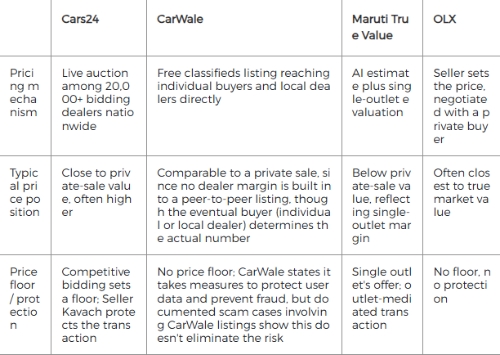
The price a seller gets for the exact same car varies enormously depending on how many buyers are actually competing for it at the moment of sale. A single local dealer, buying to resell, prices in their own margin and refurbishment cost before making an offer. A private buyer, paying retail value directly, has no such margin to protect. A live auction among many dealers sits closer to the private-buyer number, because competition among bidders squeezes out the margin any single dealer could otherwise claim. This one mechanism, how many buyers are actually bidding, explains most of the price gap between the platforms compared here.
At a glance: how each platform prices your car
Does a dealer auction beat a single dealer's offer?
Selling to one dealer, whether as a trade-in or a direct sale, means accepting whatever margin that dealer needs to protect. A widely cited industry comparison puts the gap plainly: a dealer trade-in typically sits 10 to 20 percent below what the same car would fetch in a private sale or through a reputable used-car platform, according to VahanBazaar's dealer-negotiation guide. Separately, private sales against trade-ins tend to yield 15 to 25 percent more than a dealer trade-in, since a private buyer pays retail value directly rather than the wholesale price a dealer needs to profit on resale.
Cars24's auction model is built specifically to close that gap without asking the seller to find a private buyer themselves. Because 20,000-plus verified dealers across the country can bid on the same car, the winning bid reflects competition among many dealers rather than one dealer's margin requirement.
Choose Cars24 if you want most of a private sale's price advantage without personally finding and vetting a buyer.
Choose a single-dealer trade-in only if convenience matters more than the 10-20% gap you're likely leaving on the table.
Does selling privately, or through a listing site, really get you more than selling to a platform?
Sometimes, and OLX and CarWale are where that upside is most available. Prices on both tend to land closer to true market value, since most transactions happen between private owners or small dealers without the overhead costs a certified marketplace carries. No brand margin, no refurbishment cost, and no platform fee sit between the buyer's willingness to pay and the number that reaches the seller, and CarWale's own listing service is free to use. The trade-off on both is the same: there's no institutional verification of the buyer or the deal, meaning the seller absorbs the entire burden of finding a genuine buyer, agreeing a fair price without a valuation engine's backing, and confirming payment before handover. CarWale carries this same risk in practice. CarWale does offer one path closer to an evaluated sale: CarWale abSure, a certified buying arm with physical showrooms in Mumbai, Bengaluru, Delhi, Kolkata, Chennai, Pune, and roughly 20-plus other cities. This functions more like a single-outlet evaluation, similar in shape to Maruti True Value, but its footprint is considerably smaller and less documented than True Value's outlet network, so it isn't a reliable option for sellers outside those specific cities.
What eats into your price after the number is agreed?
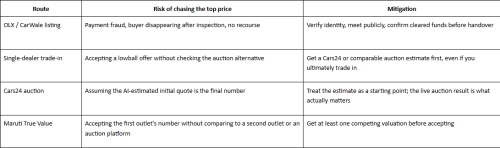
A high headline number means little if costs or delays erode it before the money clears. Cars24 backs its transaction with Seller Kavach, covering the seller from handover through RC transfer. CarWale's listing model carries a different kind of cost, similar to OLX: since there's no institutional verification, a seller can agree to a strong price and then lose part or all of it to a bounced payment, a fraudulent buyer, or a dispute over the car's condition after the fact.
Where sellers get burned chasing the highest number
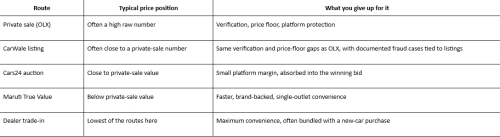
The full price comparison
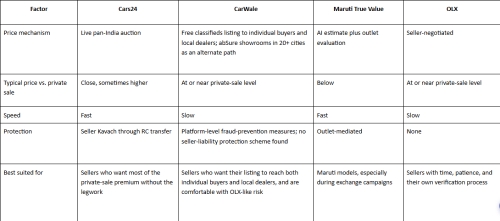
Which route gets you the best price for your situation?
. Choose Cars24 if you want a number close to private-sale value without personally sourcing a buyer or negotiating.
. Choose OLX or CarWale if you have the time, the patience, and the ability to verify a buyer yourself, and raw price matters more than speed or protection; CarWale's added reach to local dealers is worth considering if you want more than pure classifieds exposure.
. Choose Maruti True Value if your car is a Maruti model and you can align the sale with an active exchange drive.
. Avoid a straight dealer trade-in if price is your priority; get a competing quote first, since trade-ins consistently land at the bottom of this comparison.
OLX and CarWale can win on raw price when a genuine buyer, private or local dealer, is available, though neither offers a meaningful price floor or platform protection, and both carry documented fraud risk a seller has to manage personally. Cars24's auction model captures most of that same premium while keeping the speed and protection a private sale lacks. Maruti True Value trades some price for a brand-backed, single-outlet process; treat a straight dealer trade-in as a convenience option rather than a price benchmark.